From any of the three Hampden sites, Hampden Terrace is visible. Obviously through time with the growth of trees and building projects as such, the terrace has become more and more obscured from the view of passers-by, but it is still there – the marker for the naming of the first purpose-built football stadium in the world.
It is perhaps an anecdotal story that has survived over 150 years, but one that explains the naming of the most important association football location in the world – it was the first of its kind, the template that was then copied around the world. To put it into context, Wembley, formerly the British Empire Stadium, only became the home for English football in 1923, nearly 50 years after the creation of Hampden, and even then, Hampden was on version 3.0 by that point.
During the organisation of the initial Scottish Challenge Cup in 1873/74, there was uncertainty regarding the location of where Queen’s Park, recognised as the oldest football club in Scotland, as to where they actually played their football. Queens Park first played at a venue named Hampden Park on 25th October 1873. The ground was situated near a terrace which derived its name from John Hampden, an Englishman who supported the Roundheads during the English Civil War, and the Hampden name was used thereafter to locate the nearby football venue. This original venue hosted the inaugural Scottish Cup Final in 1874 and also a Scotland versus England match in 1878.
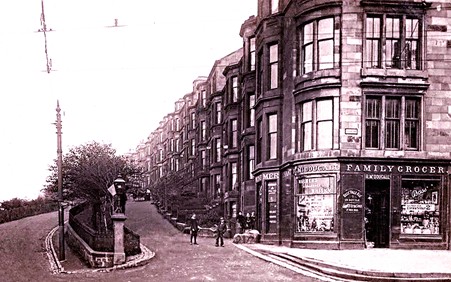
When looking at this Hampden Terrace photograph from the early 1900s, four separate stories spring to mind. One is of general interest, the second is of humour, the third is of horror and the fourth affirms my belief in a theory that events and circumstances are all indeed connected some way:
If you study the grocer’s shop window, you will see the Bass logo on the glass. Bass was a pioneer in international brand marketing and was the first trade mark to be registered under the UK’s Trade Marks Registration Act 1875.
Nothing has really changed in over 150 years or so.
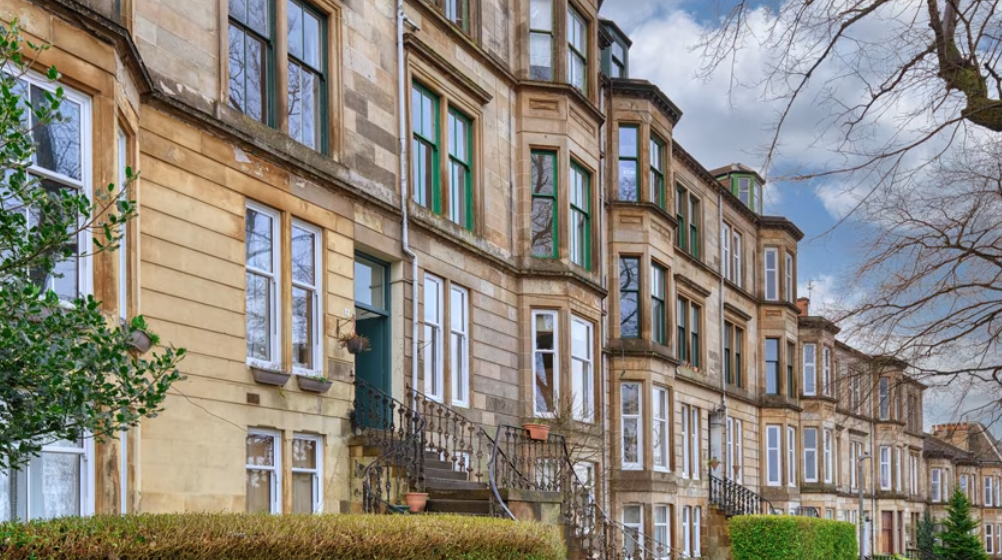
The second account recalls an incident from my childhood when I was left unattended in the family car while my parents delivered Christmas presents to residents living beyond the horse and cart depicted in the photograph. In a moment of restlessness, I moved from the back seat to the front and inadvertently released the handbrake with my foot. As a result, the vehicle gradually rolled down Hampden Terrace, crossed the junction at Cathcart Road and Prospecthill Road, and eventually halted in the Glasgow Indoor Bowling Club car park. My parents exited the building in Hampden Terrace just in time to see the car in motion and pursued it immediately.
I distinctly remember the skelp I received when I was retrieved from the vehicle and checked to see that I was safe and sound.
The third story, however, recounts a period of madness and badness that gripped the Glasgow area in the late 1950s:
Peter Thomas Anthony Manuel (13 March 1927 – 11 July 1958) was an American-Scottish serial killer convicted of seven murders in Lanarkshire and southern Scotland between 1956 and his apprehension in January 1958. He is also suspected of committing two additional murders. Before his identification and arrest, the media referred to him as “the Beast of Birkenshaw.” Manuel was executed by hanging at Barlinnie Prison in Glasgow, becoming the second-to-last individual to be executed at that facility.
6 of the murders had been committed with the use of a handgun.
Marion Watt, Margaret Brown and Vivienne Watt had been shot dead in their beds. It was later established that a Webley service revolver had been used as the murder weapon.
Peter Smart (45), his wife Doris and their 11-year-old son, Michael, were shot through the head with a Beretta pistol at point blank range while they were sleeping.
My grandfather lived at 13 Hampden Terrace while my own family lived at 8 Hampden Terrace. A downstairs neighbour at 8 Hampden Terrace was a gun collector and was forever pestering my father for rounds of ammunition that he could display beside each of the weapons he possessed.
My father served as a Lieutenant Colonel in the Cameronians (Scottish Rifles), maintaining an active role with local territorial units and frequently attending live-fire exercises. An incidental meeting with Glasgow Police regarding the logistical requirements for the Cameronians (Scottish Rifles) pipe bands to performs at football matches held at Hampden, Cathkin, and Ibrox stadiums subsequently prompted senior officers—Detective Inspector Goodall, Detective Superintendent Muncie, Detective Superintendent Brown, and Detective Inspector McNeill, who were leading the investigation into the Beast of Birkenshaw—to consult the Cameronians (Scottish Rifles) about the weaponry implicated in the murders, including inquiries about access to the calibre of bullet used.
Based on information provided by my father, police officers executed a search warrant at the residence of our downstairs neighbour and detained him, along with his firearms collection, for further investigation. It was later revealed that all of the firearms had previously been rendered inoperable and that he possessed valid permits for each weapon. Nevertheless, the relationship with the downstairs neighbour remained strained following the incident.
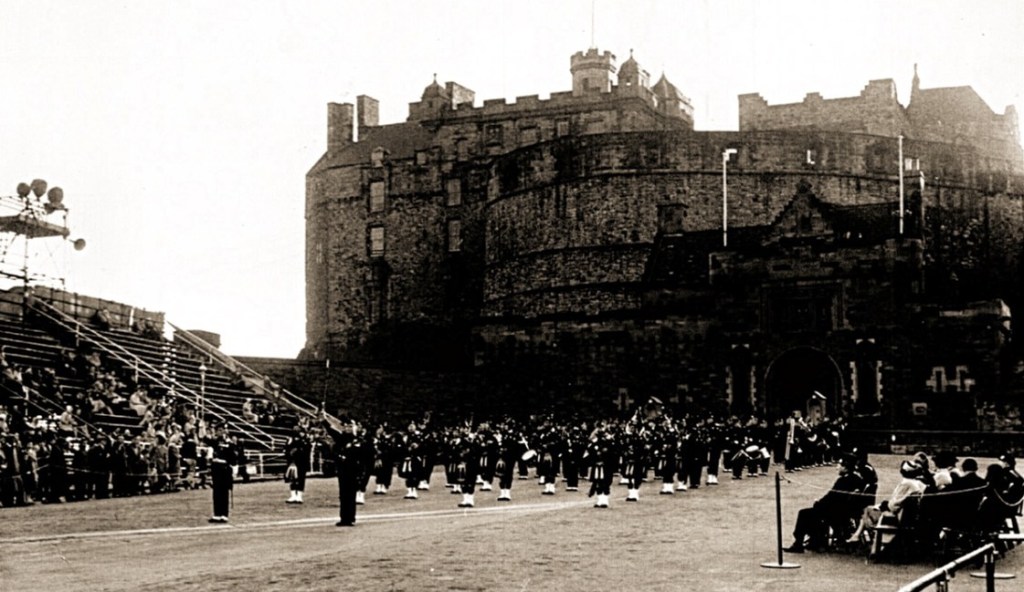
The fourth and final part of this story relates to me sorting through my late father’s papers. I came across a military scrapbook with photos from his time as a Lieutenant Colonel in the Cameronians (Scottish Rifles) in 1958. These images helped me uncover a story that may have been forgotten for nearly 70 years.
The photo above is of the Cameronians (Scottish Rifles) rehearsing ahead of the 1958 military tattoo at Edinburgh Castle. My father is one of those seated on the right.
After a wee bit of searching and investigation, I was able to establish that a Lieutenant Colonel Duncan Maclachlan Carter-Campbell of Possil (8th of Possil), OBE, served with the Cameronians (Scottish Rifles) and subsequently held the position of Secretary to the General Officer Commanding-in-Chief of Scottish Command and Governor of Edinburgh Castle, Lieutenant-General Sir George Collingwood. Additionally, he was appointed Director of the Royal Edinburgh Military Tattoo prior to his retirement in 1962.

This information further piqued my interest, as I was already aware that the Campbells of Possil were among the early participants in cricket and football in the Glasgow area, playing a significant role in the establishment of football as a sport.
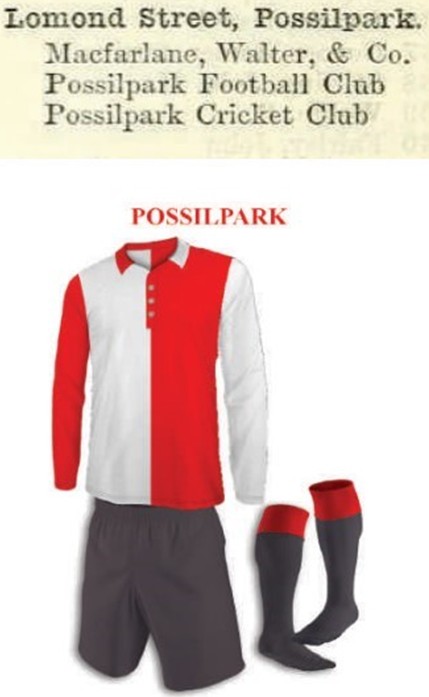
The Campbells of Possil were a prominent family whose social and commercial status originated from prosperous tobacco and sugar enterprises in the Americas and the West Indies. Operating under the name John Campbell Senior & Co., the family generated substantial wealth for the city and employed their resources strategically in expanding business ventures, acquiring property, and maintaining distinguished lifestyles.
Possil House was far enough away from the noise and smoke of the city to become a home in the country. Surrounded by trees and featuring beautiful gardens with grassy slopes running towards a central clear water lake, Possil was regarded “as delightful and retired a residence as any in the country”, but yet again, the expansionist tentacles of Glasgow’s industrialisation reached the estate and it was all gone by the mid-1880s.
As I looked through the scrapbook, I managed to reconstruct what happened on a Saturday morning in late April 1958, hours prior to Scottish Cup Final taking place at Hampden. Discovering these photographs made me proud as I now had the opportunity to share their stories once again.
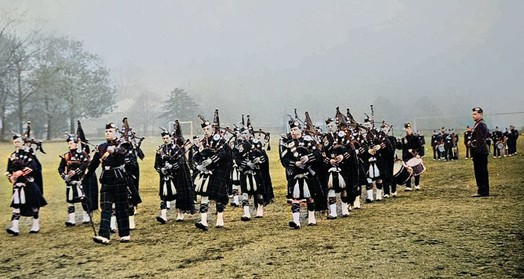
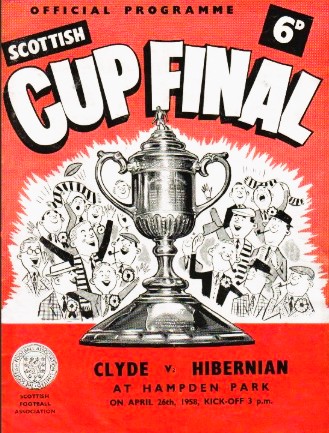
My father had supervised the Cameronians (Scottish Rifles) as they completed their final rehearsals on the drill ground at Kingarth Street, near Victoria Road. This took place just before they marched to Hampden for the 1958 Scottish Cup Final between Clyde and Hibernian, held on Saturday, April 26th, with Clyde winning 1-0 before a crowd of 95,123 spectators. Interestingly, the parade ground in Kingarth Street had previously served as a training location for both Queen’s Park and Third Lanark Football Clubs.

In the photo above, the Pipe Sergeant displays the badge of the 3rd Lanark Rifle Volunteers on his bagpipes. The 3rd Lanark unit served as the militia for the Cameronians (Scottish Rifles) and was among the eight founding clubs of the Scottish Football Association. Additionally, they participated in the first Scottish Football Challenge Cup during the 1873/74 season.
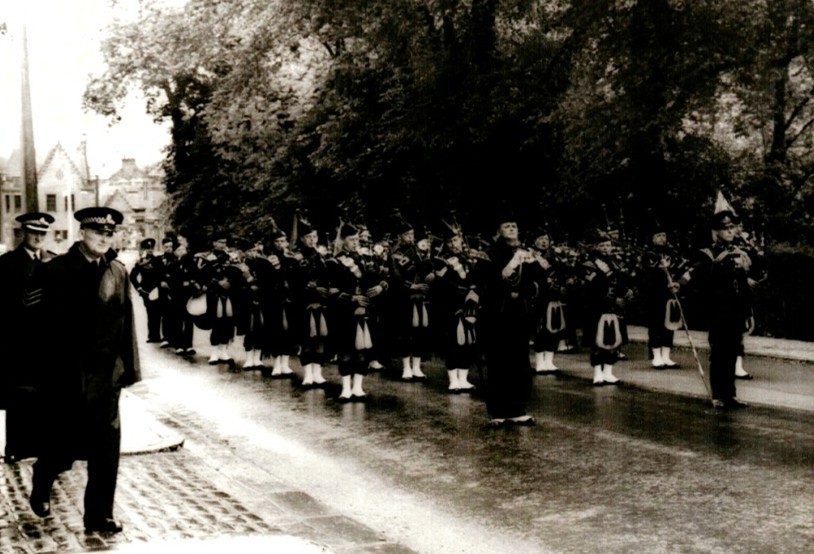
It must have been an impressive site on cup final day to watch the troops march through the south side to Hampden.
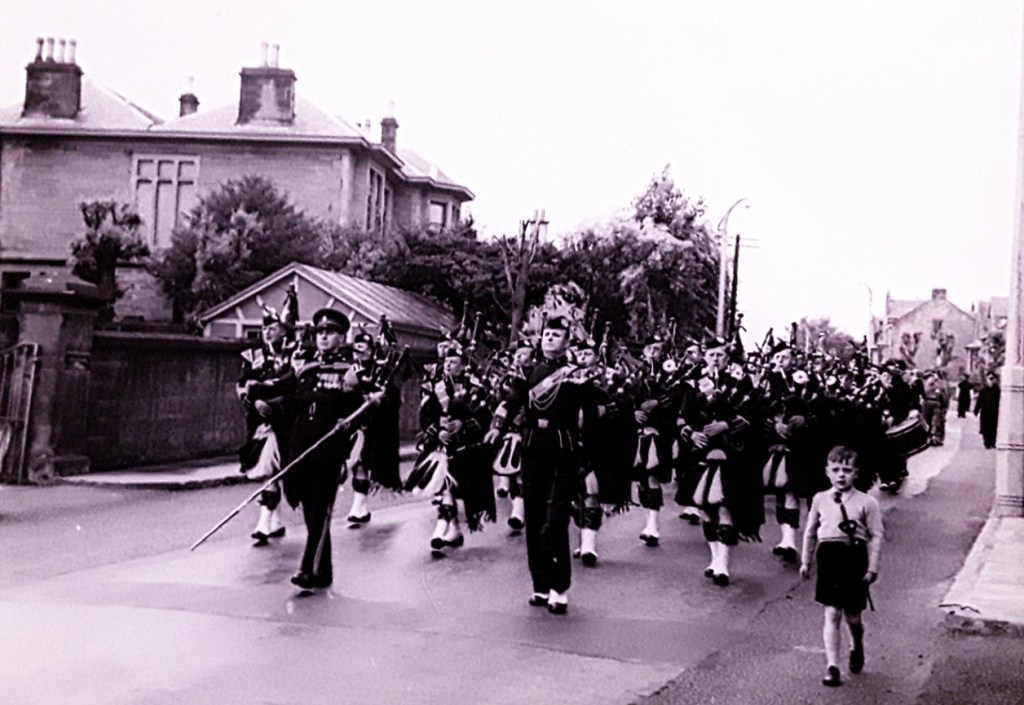
I love this photo of the wee lad marching with his sword tucked into his waistband – I can hear the ‘Black Bear’ playing as he keeps in step ahead of the troops. The wee lad will be about 80 now and I have always wondered if he remembers the day?
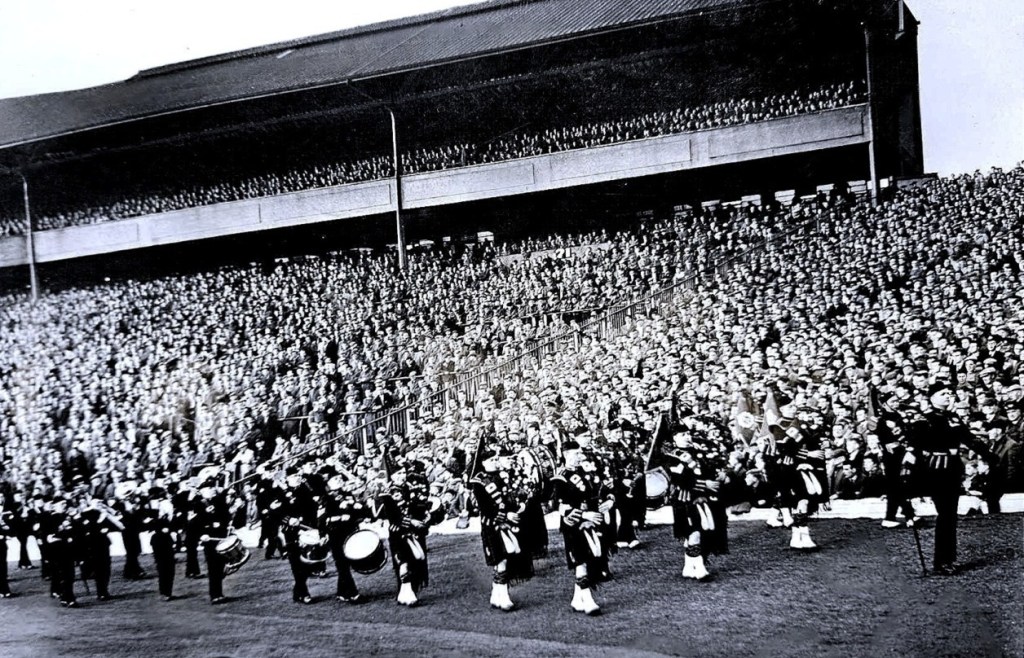
The Cameronians (Scottish Rifles) performing on the pitch at Hampden ahead of the 1958 cup final.
Inside what is now known as Football’s Square Mile, a series of seemingly random events and actions have intersected over time, creating a history that has never really been appreciated before. When these occurrences are brought together and examined side by side, they reveal a pattern of unexpected connections—serendipitous links that prompt us to reflect on coincidence and the blending of influences, forming a sporting narrative unlike any other.
Chance relationships shaped by circumstances can lead to positive outcomes and, although all of the above were unplanned, connections emerged unexpectedly between them all and fostered opportunities for growth and understanding.
We can now appreciate, in detail, the enormity of a past we have forgotten about.
 As the Willow Returns
Leave a comment